The way people search for businesses is changing.
When looking at SEO vs AEO, the biggest mistake is assuming your business needs to choose between them. A strong strategy uses SEO to build visibility and AEO to make your expertise easier to find, understand and use in an answer.
For years, a small business trying to get found online focused heavily on one thing:
SEO.
Search Engine Optimization helped businesses improve their visibility when someone searched Google for a product, service or answer.
SEO still matters.
A lot.
But people aren’t only searching with short phrases anymore.
They’re asking complete questions.
They’re using Google AI features, ChatGPT, Microsoft Copilot and other AI-powered tools to research businesses, compare options and find answers.
That’s why you’re starting to hear another term:
AEO — Answer Engine Optimization.
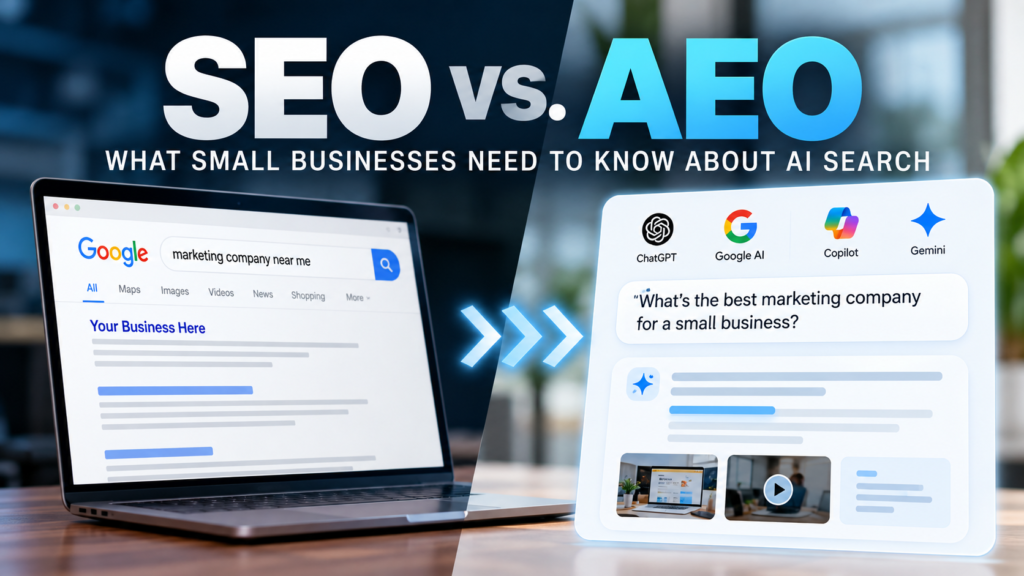
So what’s the difference between SEO vs AEO?
And does your small business actually need both?
The short answer:
SEO helps search engines find and understand your website. AEO focuses on making your information clear, useful and easy to use when answering a person’s question.
But here’s the important part:
AEO doesn’t replace SEO.
The two work together.
When comparing SEO vs AEO, don’t think of it as choosing one or the other. SEO helps create the foundation that allows search engines to discover and understand your content. AEO builds on that foundation by making your expertise easier to understand when someone asks a specific question. For small businesses, the strongest strategy is using SEO and AEO together.
What Is SEO?
SEO stands for Search Engine Optimization.
It’s the process of helping search engines discover, understand and potentially rank the content on your website.
For a small business, SEO can include:
- Creating useful website content
- Optimizing service pages
- Using descriptive page titles and headings
- Improving website speed and mobile usability
- Building internal links
- Keeping business information accurate
- Creating content around questions customers are searching for
- Making sure search engines can crawl and index your website
Imagine you own a roofing company.
Someone searches:
“roofing contractor near me”
Traditional SEO can help search engines understand what your company does, where you operate and whether your website might be relevant to that search.
But search behavior is becoming more conversational.
Instead of searching:
“roofing contractor near me”
someone might ask:
“How do I know if I need to replace my roof or if it can be repaired?”
That’s where the conversation around AEO becomes important.
What Is AEO?
AEO stands for Answer Engine Optimization.
The SEO vs AEO conversation becomes easier to understand when you think about how people search. SEO helps position your content to be discovered, while AEO puts additional focus on answering the specific questions people are asking.
AEO focuses on creating clear, useful information that directly answers the questions people are asking.
Instead of thinking only about keywords, you start thinking about questions, intent and answers.
For example:
A customer doesn’t necessarily search:
“CRM small business.”
They might ask:
“What’s the easiest way for a small business to follow up with website leads automatically?”
Your content should help answer that question.
That might mean creating:
- Helpful blog articles
- Detailed service pages
- Frequently asked questions
- How-to guides
- Videos
- Comparisons
- Original examples
- Clear explanations based on your experience
The goal isn’t to write for a robot.
It’s almost the opposite.
Answer real questions better.
If your content clearly explains something people want to know, search engines and AI-powered systems have better information to understand and potentially reference.
SEO vs AEO: What’s the Difference?
The easiest way to understand SEO vs AEO is this:
SEO helps you become discoverable.
AEO helps make your content useful for answering questions.
There’s significant overlap between the two.
SEO may focus on things like:
Search visibility → Crawling → Indexing → Relevance → Rankings → Clicks
AEO puts additional emphasis on:
Questions → Clear answers → Context → Expertise → Trust → Citations and discovery
But they shouldn’t be treated as competing strategies.
In fact, Google has made an important point about this.
Its guidance for generative AI search says traditional SEO best practices remain relevant because Google’s AI search features are built on its core Search ranking and quality systems.
In other words:
You don’t abandon SEO to prepare for AI search.
You build on a strong SEO foundation.
That’s why SEO vs AEO shouldn’t be viewed as a battle. AEO builds on many of the same fundamentals that already make good SEO work.
Does AEO Replace SEO?
No.
This may be one of the biggest misconceptions surrounding AI search.
There’s no reason for a small business to suddenly stop caring about:
- Website structure
- Crawlability
- Indexing
- Internal links
- Page experience
- Helpful content
- Search intent
- Accurate business information
Those things still matter.
Google specifically says that pages generally need to be indexed and eligible to appear in Google Search before they can appear as supporting links in AI Overviews or AI Mode.
Google also says there aren’t special technical requirements or special AI schema required just to appear in those experiences.
That’s important.
You don’t need to chase every new AI-search hack.
You need a strong website with valuable information that search engines can access, understand and trust.
How Is AI Changing Search?
Traditional search often looked something like this:
Search → Results → Website → Answer
AI-powered search can look different:
Question → AI-generated answer → Sources → Website
That changes how businesses should think about visibility.
Being #1 for one exact keyword isn’t the only opportunity anymore.
A person might ask:
“What’s the best way for a local business to generate leads without spending a fortune on ads?”
An AI system may need information about several related topics to answer that question:
- Local SEO
- Website conversion
- Lead magnets
- Content marketing
- CRM systems
- Follow-up
- Automation
- Advertising
That creates an opportunity for businesses that build genuine expertise around the problems they solve.
Your website shouldn’t contain one page stuffed with every keyword you can think of.
It should become a library of useful information around your area of expertise.
How Can a Small Business Optimize for SEO and AEO?
You don’t need hundreds of AI-generated articles.
Start with the questions your customers already ask.
1. Identify Real Customer Questions
Listen to your customers.
What do they ask before buying?
What confuses them?
What stops them from moving forward?
What do they compare?
What are they worried about?
Those questions can become incredibly valuable content.
For example, a contractor might hear:
“Should I repair my siding or replace it?”
That’s a potential article.
A pharmacist might hear:
“Why am I taking this medication?”
That’s potential educational content.
A marketing company might hear:
“Why am I getting website traffic but no leads?”
There’s another article.
The best content ideas are often already hiding inside your everyday customer conversations.
2. Answer the Question Early
Don’t make someone read 800 words before getting an answer.
If the heading asks:
Does AEO Replace SEO?
Answer it immediately:
No. AEO does not replace SEO.
Then explain why.
This helps your reader.
It also creates a clear passage that search and AI systems can understand.
3. Create Original, Useful Content
AI has made creating average content incredibly easy.
That’s exactly why average content is becoming less valuable.
Don’t publish another article that simply rearranges information already available on 500 other websites.
Add something.
Your experience.
Your process.
A real example.
An opinion you can support.
A lesson learned working with a customer.
A useful checklist.
An original video.
A framework.
Google’s current guidance for generative AI search specifically encourages unique, valuable, non-commodity content.
That’s a fancy way of saying:
Give people something they couldn’t get from 100 identical articles.
4. Use Clear Headings and Structure
Make your content easy to understand.
Use descriptive headings.
Keep paragraphs relatively short.
Use lists when they genuinely make information easier to scan.
Organize related ideas together.
Don’t make the reader hunt for the answer.
Good structure helps humans understand your content.
And that’s the priority.
5. Build Topic Authority Over Time
One article probably won’t establish your business as the definitive resource on a subject.
Build around topics.
For example, at 7 Theory Marketing, one of our core topics is helping small businesses create a connected marketing system.
That can include content about:
- SEO
- AEO
- Websites
- Lead generation
- Content
- CRM systems
- AI
- Marketing automation
- Follow-up
- Conversion
Each article can answer a specific question while connecting naturally to related resources.
That’s much more useful than publishing random articles simply because a keyword has search volume.
6. Connect Your Content With Internal Links
Your website should help visitors move from one useful resource to another.
For example, if you’re reading this because you ultimately want more customers, SEO and AEO are only part of the equation.
SEO vs AEO is ultimately about getting discovered and providing better answers. But getting discovered is only the beginning.
You still need a system to turn that attention into an opportunity.
That’s why we recommend starting with our guide:
How to Get More Leads for Your Small Business
That article explains how your website, content, CRM, automation and follow-up can work together instead of operating as separate marketing tools.
Internal links also help search engines discover related pages and better understand the relationships between your content.
7. Make Sure Your Website Can Actually Be Crawled and Indexed
Great content doesn’t help much if search engines can’t access it.
Your website should have a clear technical structure.
Important pages shouldn’t be accidentally blocked from crawling or indexing.
Your content should be accessible through internal links.
Your website should work well on mobile devices.
Your sitemap should accurately reflect the pages you want search engines to discover.
SEO still provides the technical foundation beneath AEO and AI-search visibility.
Can AEO Help My Business Appear in ChatGPT?
Potentially — but nobody can guarantee it.
That’s an important distinction.
There isn’t a button you push that says:
“Put my business in ChatGPT.”
Different AI systems retrieve, rank, cite and generate information differently.
That’s also why an SEO vs AEO strategy shouldn’t be built around promises of guaranteed placement in AI-generated answers.
What you can control is the quality and accessibility of your online presence.
Build authoritative pages.
Clearly explain what you do.
Answer specific questions.
Publish original information.
Keep important information accurate.
Make your website easy to crawl.
Build your authority around the subjects your business genuinely understands.
The goal isn’t to trick an AI system into mentioning you.
The goal is to become a source worth mentioning.
What Type of Content Works for SEO and AEO?
Start with content that helps someone make a decision or solve a problem.
Good examples include:
- “How much does _____ cost?”
- “What’s the difference between _____ and _____?”
- “How do I choose _____?”
- “What should I look for in _____?”
- “Is _____ worth it?”
- “How long does _____ take?”
- “What happens if _____?”
- “What are the biggest mistakes when _____?”
- “Do I need _____?”
- “What’s the best way to _____?”
Notice something?
Those aren’t just keywords.
They’re conversations.
And that’s increasingly how people interact with search and AI.
How Do You Measure AEO and AI Search Visibility?
This area is evolving quickly, but measurement is improving.
Google Search Console now provides reporting around visibility within Google’s generative AI search features.
Microsoft has also introduced AI Performance reporting in Bing Webmaster Tools, including information about pages cited in AI-generated answers and the queries used to retrieve them.
That’s a significant shift.
Businesses are beginning to gain visibility into not only:
“Did my page rank?”
but also:
“Was my content used or cited in an AI-generated answer?”
Over time, those signals can help businesses understand which content is actually establishing authority.
But don’t lose sight of the business outcome.
At 7 Theory Marketing, we’d still want to connect visibility to what happens next:
Attention → Website → Lead → Conversation → Opportunity → Customer
Because a million AI citations don’t pay the bills if none of them create the right opportunities.
SEO vs AEO: Which Should Your Small Business Focus On?
Both.
But don’t think of them as two completely separate marketing strategies.
Think of it this way:
SEO builds the foundation.
AEO makes your expertise easier to understand and use when people ask questions.
And your overall marketing system turns that visibility into an opportunity.
That’s the piece businesses can’t forget.
Getting found isn’t the finish line.
It’s the beginning.
Someone discovers your business.
Then what?
Do they understand what you do?
Can they find the answer they need?
Do they trust you?
Is there an obvious next step?
Can they become a lead?
Does someone follow up?
That’s where SEO, AEO and your marketing system come together.
Frequently Asked Questions About SEO vs AEO
What does AEO mean?
AEO stands for Answer Engine Optimization. It generally refers to creating and structuring useful content so that it clearly answers the questions people ask through search engines and AI-powered answer experiences.
What is the difference between SEO and AEO?
SEO focuses broadly on improving a website’s visibility and performance in search engines. AEO emphasizes making information clear and useful for answering specific questions. There is substantial overlap, and strong SEO remains an important foundation for AI-powered search visibility.
Does AEO replace SEO?
No. AEO does not replace SEO. Google’s own guidance says existing SEO best practices remain relevant to its generative AI search features.
Does my small business need AEO?
If potential customers research your products, services or industry online, creating content that clearly answers their questions can be valuable. However, it should be built on solid SEO fundamentals rather than treated as a replacement for SEO.
How do I optimize my website for AI search?
Start with the fundamentals: make your website crawlable and indexable, create original and useful content, answer real customer questions clearly, use descriptive headings, connect related pages with internal links and keep your information accurate.
Is there special AEO schema I need to install?
Not specifically for appearing in Google’s AI Overviews or AI Mode. Google says there is no special schema.org structured data required for its AI features. Any structured data you do use should accurately match the content visitors can see on the page.
Can I guarantee my business will appear in AI answers?
No. Search engines and AI platforms ultimately determine which sources they use or display. Strong SEO, useful content and clear expertise can improve your opportunity for visibility, but no legitimate strategy can guarantee inclusion in a particular AI-generated answer.
Get Found. Then Be Ready for What Happens Next.
A strong SEO vs AEO strategy can help more people discover your business and find useful answers when they’re researching what you offer.
But discovery alone doesn’t create a customer.
Your website, lead capture, CRM, follow-up and automation still need to work together after someone finds you.
That’s why we created the IMPACT7™ Checklist.
It helps you look at seven important areas of your marketing and identify where opportunities may be slipping through the cracks.
Instead of adding another marketing tool, start by finding the gaps in the system you already have.
Get the Free IMPACT7™ Checklist →
Get found. Capture the opportunity. Start the conversation.
Leave a Reply